
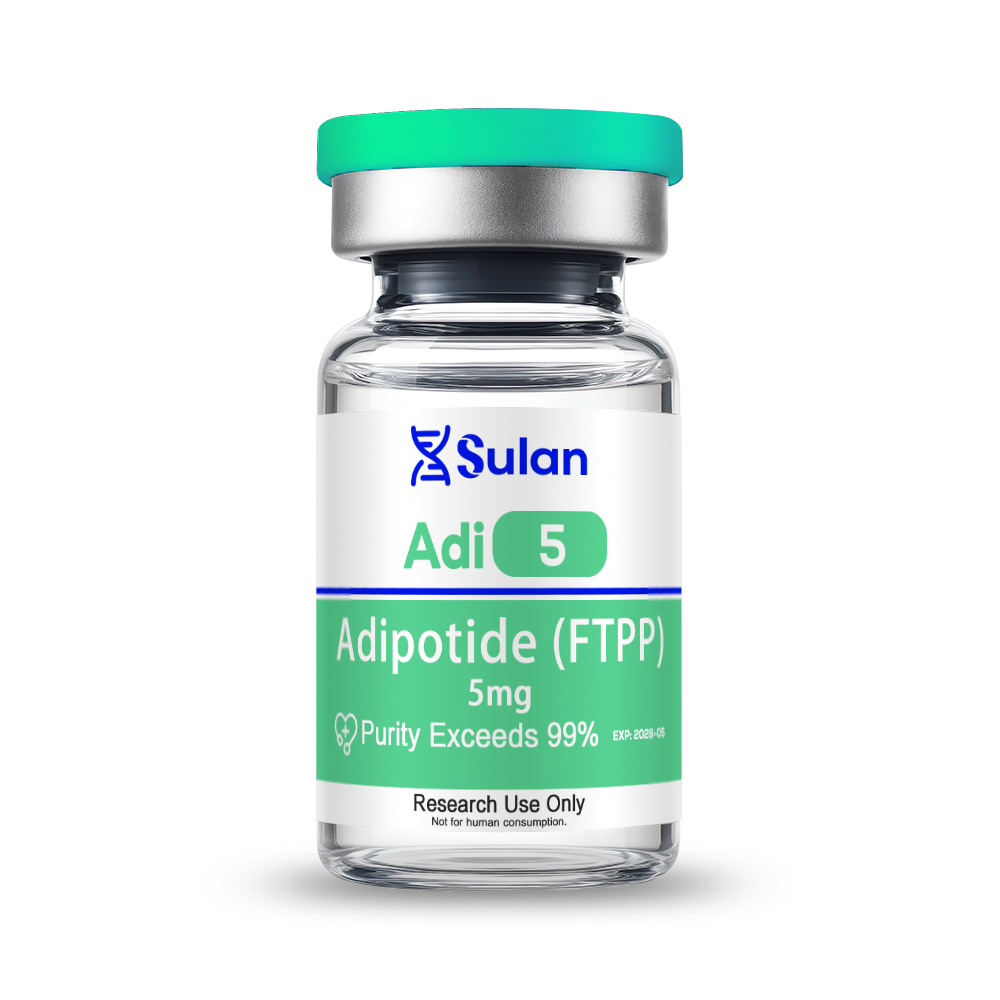
Adipotide (FTPP)
This price is for one box, with ten pieces per box
- only 30 left in stock
- 54 people are viewing this right now
- 221 people has purchased this in 7 days
 Returns & Exchanges within 30 daysAny return for unsatisfied item(s) is available within 30 days
 Money Back GuaranteeA full refund within one week upon receiving your return
 3-Month WarrantyCovering any possible defect in materials and workmanship
 Safety AssuranceOur products are strictly tested and quality assured


Adipotide Peptide (FTPP)
Adipotide Peptide, also known as FTPP (Fat-Targeted Proapoptotic Peptide), fat-targeted proapoptotic peptide, or proapoptotic peptide, has been widely researched and is posited by scientists to be a proapoptotic peptide that may contribute to cell apoptosis. Adipotide may possibly act as a peptide targeting prohibitin, which is why it also bears the name Prohibitin-targeting peptide 1 (Prohibitin-TP01). Current research is still exploring Adipotide’s potential in this area and its potential actions related to its targeting properties. (1) Prohibitins are natural proteins considered by scientists to regulate such functions as cell formation, metabolism, and inflammation.
Research teams initially considered Adipotide for its supposed potential to mitigate the action of cancer cells. Still, the peptide indicated it may have research potential for experiments investigating lipolysis and obesity mitigation, leaving the research pioneers “ at a loss of words .” (2) It was presumed that Adipotide might prevent blood supply to the cancer cells, resulting in cell death and malignant cell growth inhibition. Upon further research, it was suggested by the scientists that the peptide appeared to exhibit the same mechanism of action but on fat cells instead. This “ proof of concept ” study was an early-stage experiment suggesting that the peptide may have significant potential. Yet, the compound has to be studied further to understand its full potential and impact on cells.
Overview
Researchers isolated a naturally occurring peptide (sequence CKGGRAKDC) via phage display methodology and combined it with a proapoptotic sequence, forming the now-termed Adipotide compound. Adipotide is homologous to the peptide sequence found in the white adipose tissue. Owing to this development and characteristics, researchers suggest that the peptide may possibly target the prohibitin PHB1 found at the surface of the adipose ti