
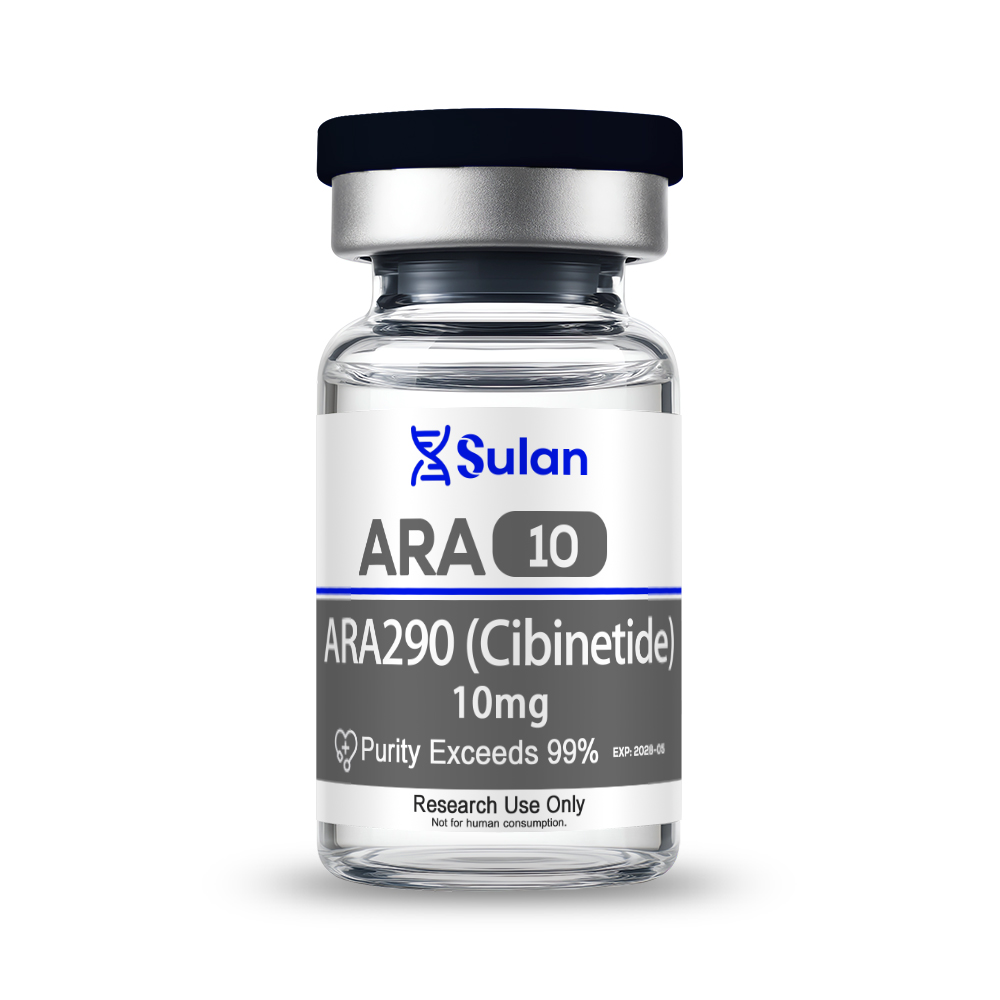
ARA-290 (10mg)
This price is for one box, with ten pieces per box
- only 25 left in stock
- 51 people are viewing this right now
- 225 people has purchased this in 7 days
 Returns & Exchanges within 30 daysAny return for unsatisfied item(s) is available within 30 days
 Money Back GuaranteeA full refund within one week upon receiving your return
 3-Month WarrantyCovering any possible defect in materials and workmanship
 Safety AssuranceOur products are strictly tested and quality assured


ARA-290 Peptide
ARA-290 peptide, also known as cibinetide and helix B surface peptide (HBSP) in scientific literature, is an 11 amino acid chain derived from the beta domain of the naturally-occurring protein erythropoietin (EPO). This part of the EPO sequence is considered to assist in tissue regeneration and repair without exerting stimulus on the production of red blood cells. (1) Scientists consider the primary function of the EPO is to stimulate tissues to produce red blood cells. Still, the beta domain of the protein, and consequently ARA-290, do not appear to possess this property. Instead, they may possess certain potential regenerative, anti-inflammatory, anti-nociceptive, and other lesser-known properties of the original naturally occurring EPO protein.
Overview
Scientific findings (2) thus far suggest that once a tissue undergoes an injury, a tissue-protective receptor (TPR) pathway may be activated. This TPR receptor mainly consists of a beta receptor unit (CD131) and a subunit from the EPO receptor, jointly called the innate repair receptor. Researchers have suggested that the ARA-290 peptide molecule may bind to this innate repair receptor and possibly attenuate nerve and allodynia-led pain (nociception). (3) It is also suggested that the ARA-290 peptide may act primarily via this IRR-mediated pathway.
Chemical Makeup
Molecular Formula: C 51 H 54 N 16 O 21 Molecular Weight: 1257.3 g/mol Other Known Titles: PH-BSP
Research and Clinical Studies
ARA-290 Peptide and Nociception
Scientists consider that Transient Receptor Potential (TRP) channels may be the primary nociceptive stimulating channels, including possible thermal, chemical, and mechanical stimuli. In the presence of such a causative agent, one of the TRP channels, namely TRPV1, may be triggered. Upon activation, it might induce the ejection of neuropeptides, which then are considered to generate action potential in the nervous systems. This action potential is re