
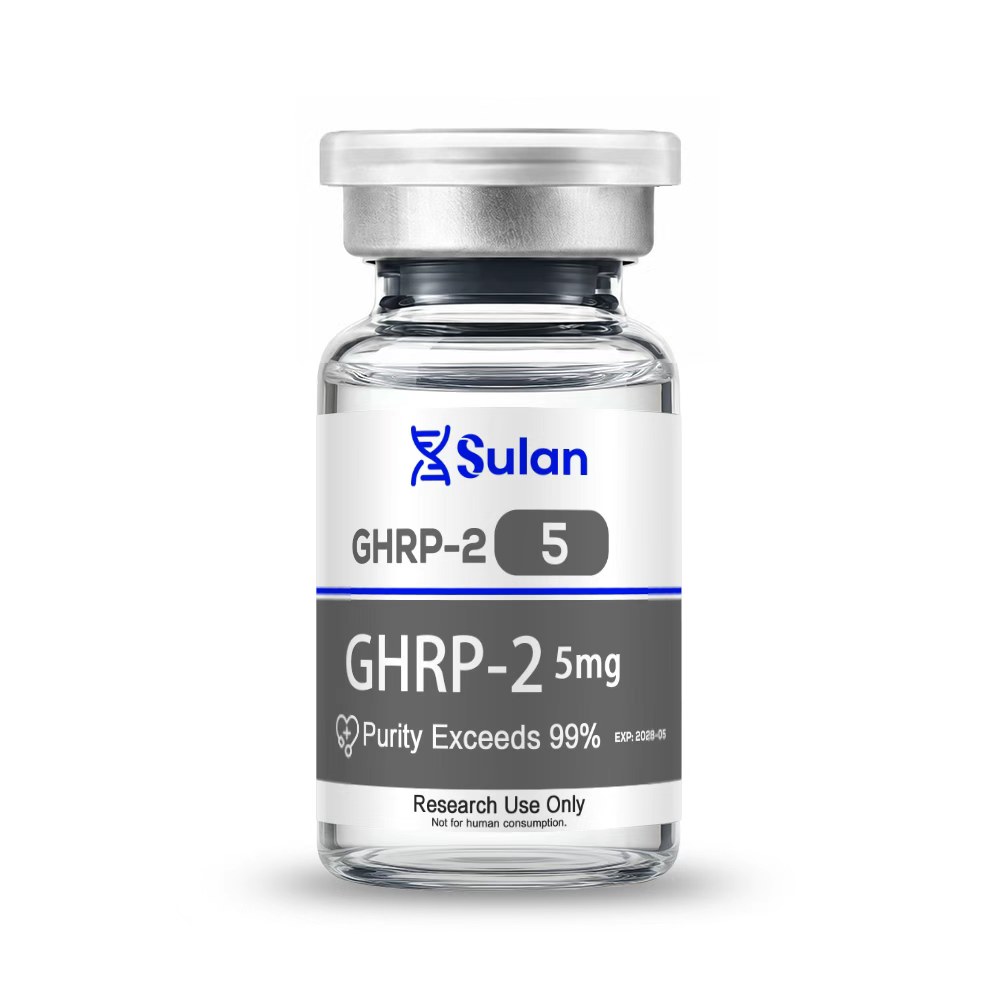
GHRP-2
This price is for one box, with ten pieces per box
- only 31 left in stock
- 22 people are viewing this right now
- 200 people has purchased this in 7 days
 Returns & Exchanges within 30 daysAny return for unsatisfied item(s) is available within 30 days
 Money Back GuaranteeA full refund within one week upon receiving your return
 3-Month WarrantyCovering any possible defect in materials and workmanship
 Safety AssuranceOur products are strictly tested and quality assured


GHRP-2 Peptide
GHRP-2 is a synthetic peptide made of five amino acids (pentapeptide) analogous to the endogenous neurotransmitter met-enkephalin. (1) Yet, the peptide appears to lack any neurotransmitter-like properties and instead appears to activate the receptors for the hormone ghrelin. Ghrelin is a naturally occurring hormone that is posited to regulate food intake. (11) Growth hormone-releasing peptide GHRP-2 may induce the secretion of growth hormone (GH) by apparently activating the ghrelin receptors on the pituitary gland, also termed as growth hormone secretagogue receptors (GHS-Rs).
Overview of GHRP-2 Mechanisms
Bovine studies have suggested that GHRP-2 peptide exhibits multifaceted impacts, but its main mechanism of action appears to involve the GHS-Rs. These receptors are naturally triggered by ghrelin and may be found in various parts of the nervous system and other tissues. In the nervous system, they are located in the hypothalamus and the pituitary, among other structures. When GHRP-2 appears to engage with GHS-Rs, it’s believed that a structural transformation might be triggered upon attachment, possibly initiating intracellular signaling networks primarily mediated through G-proteins. The release of Gαq/11, a component of the G-proteins, might commence, potentially setting off subsequent signaling sequences. Phospholipase C (PLC) may split phosphatidylinositol 4,5-bisphosphate (PIP2) into secondary signaling molecules, IP3 and DAG (diacylglycerol). IP3 is thought to prompt the release of calcium ions. In contrast, DAG may activate protein kinase C (PKC), potentially heightening the signaling pathway and possibly facilitating the secretion of growth hormone from pituitary cells. Moreover, this process may also involve the activation of cyclic AMP (cAMP), which plays a crucial role in cellular signaling. Increasing cAMP levels may further enhance the signaling cascade, potentially boosting GH synthesis. (13)(14) Nevertheless, GHRP-2 app