
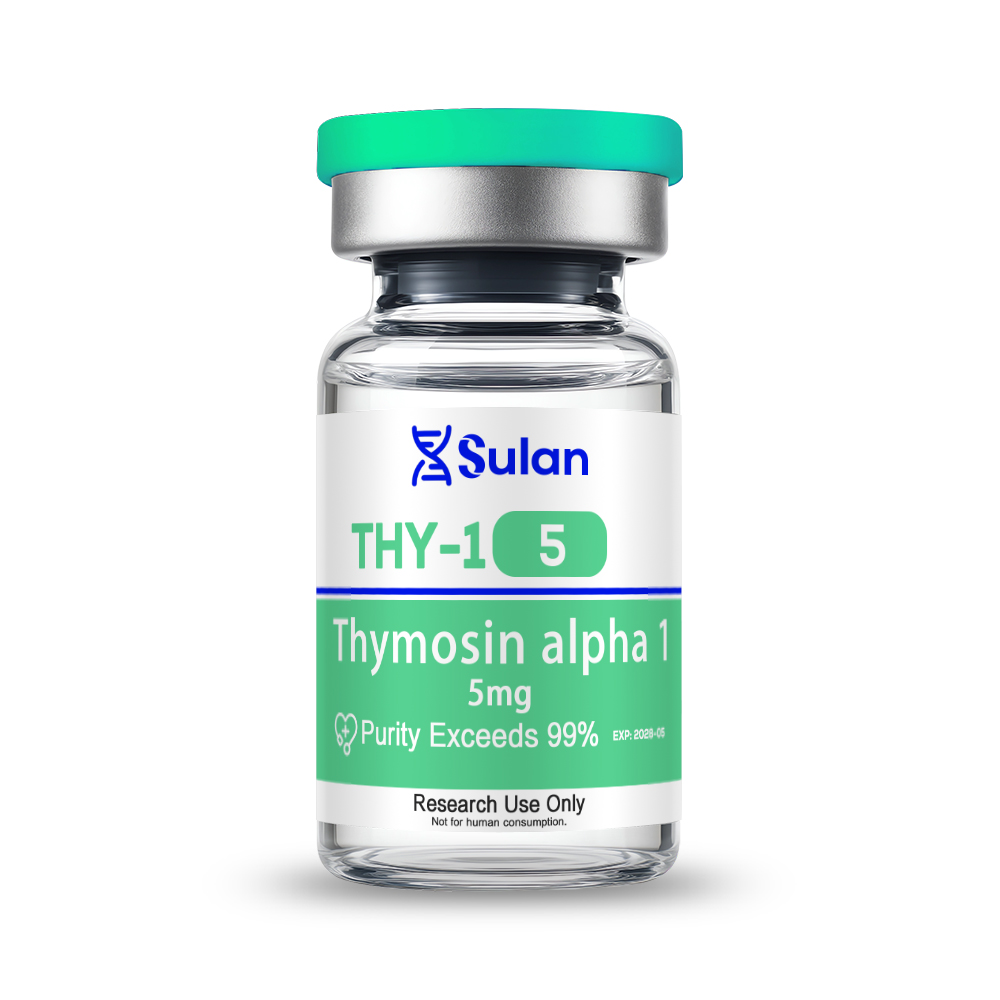
Thymosin Alpha-1
This price is for one box, with ten pieces per box
- only 28 left in stock
- 51 people are viewing this right now
- 305 people has purchased this in 7 days
 Returns & Exchanges within 30 daysAny return for unsatisfied item(s) is available within 30 days
 Money Back GuaranteeA full refund within one week upon receiving your return
 3-Month WarrantyCovering any possible defect in materials and workmanship
 Safety AssuranceOur products are strictly tested and quality assured


Thymosin Alpha-1 Peptide
Thymosin Alpha-1 peptide, also known as Thymosin Alpha, TA1, or T α 1, is a fragment of a protein molecule that has been widely studied for its potential implications with the immune system. Researchers have hypothesized that it contributes to the production of T-cells to mitigate and alleviate infection and bacterial spread. (1)
Thymosin Alpha-1 is a naturally occurring polypeptide that is considered by researchers to potentially restore and enhance immune functions. (2) Thymosin Alpha-1 is considered to be one of the polypeptides found in Thymosin Fraction 5, which is a crude extract of the thymus gland. (3)
Since its discovery, a synthetically developed form of Thymosin Alpha-1 has also been studied, researchers refer to the peptide as Thymalfasin. (2) Thymalfasin is composed of 28 amino acids, similar to the naturally occurring Tα 1, and is derived from a longer polypeptide precursor composed of 113 amino acids, known as Prothymosin Alpha. (3)
Overview
The main aim of initial research into Thymosin Alpha-1 (4) was to understand and examine the immunomodulating potential of the peptide. Studies have suggested that the peptide may increase the concentration of the major histocompatibility complex (MHC) class I and cytokine production, which may possibly lead to increased immune responses. The peptide may also enhance the activity of natural killer cells and foster the expression of phenotypic markers on T cells, suggesting a multi-faceted role in modulating the immune response. The researchers posited that the peptide may also increase the expression of high-affinity receptors for interleukin-2. This could potentially lead to a more vigorous activation and proliferation of T lymphocytes.
Researchers speculate that Thymosin Alpha-1 may stimulate possible action by targeting the T-helper cells and cytotoxic T-cell populations. (3) Tα 1 may possibly induce differentiation of the T-cells (thymocytes) a